
How do I know if my Amazon PPC is profitable?
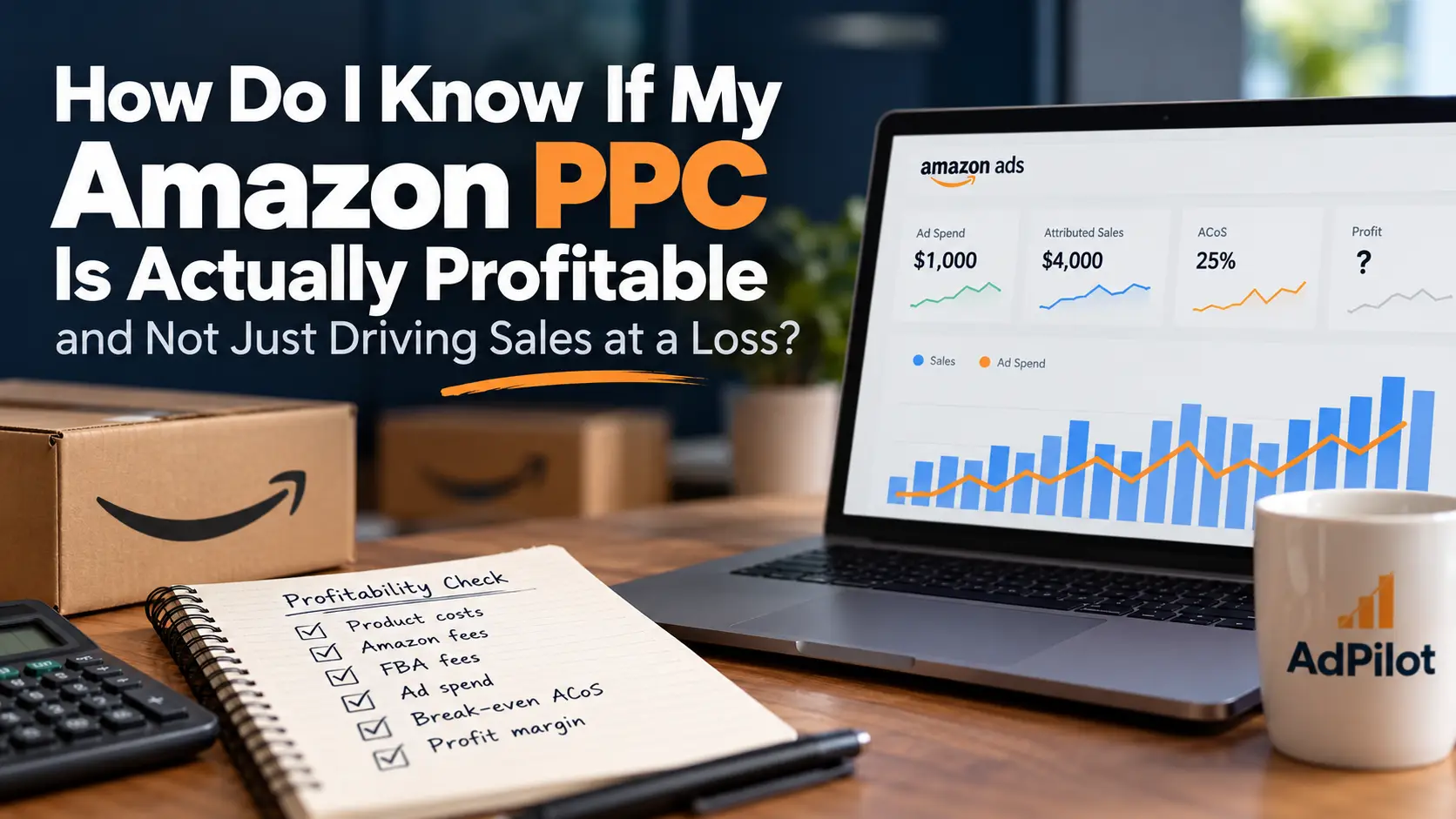
Your ads spent $1,000. They generated $4,000 in attributed sales. Your ACoS is 25%.
Looks profitable, right? Not necessarily.
One of the biggest mistakes Amazon sellers make is assuming that a campaign generating sales is also generating profit. Amazon Ads Manager is very good at showing you how much you spent and how much attributed revenue came back. What it does not tell you is how much money you actually kept, and that is the number that matters.
Amazon PPC sales are not the same as Amazon PPC profit
Take a product that sells for $40. Your landed product cost is $12, and Amazon fees and fulfillment take another $12. That leaves $16 before you spend anything on advertising, which puts your break-even ACoS at roughly 40%.
Spend $10 to win that $40 sale and your ACoS is 25%. You keep $6. Spend $18 to win the same sale and your ACoS is 45%, so you are down $2 on that order.
Both look like wins in Ads Manager. Orders are coming in, the conversion is recorded, the campaign looks healthy. But in the second case you are paying Amazon to move a unit at a loss on that attributed sale.
That is why “what is my ACoS?” is the wrong question. The better one is:
What is my ACoS compared with the actual profit margin of this product?
Start with your break-even ACoS
Every product you advertise should have a break-even ACoS: the point where what you make before advertising exactly equals what you spend to acquire the sale.
If a product sells for $50 and you have $15 left after product cost, FBA fees, referral fees and other variable costs, your pre-advertising margin is 30%. That makes your break-even ACoS roughly 30%. Spend less than that and there is room for profit. Spend more and the attributed sale is probably losing money.
This is the number most sellers never calculate, and it is the one that gives ACoS any meaning at all. A 20% ACoS can be excellent on one ASIN and terrible on another. That is also why a single ACoS target applied across a whole catalog causes problems: it is a rule that ignores the economics of every product it governs.
If you want to run the numbers on a specific ASIN, our Amazon CPC calculator works out your break-even ACoS and maximum bid from your own margin, and there is a longer walkthrough of how to use it if you want the reasoning behind the math. Working out the margin itself is a separate job, and we cover that in Amazon profit margin.
Look at contribution profit, not revenue
A better way to judge PPC is to work backward from what you keep. For every advertised sale, take the selling price and subtract referral fees, fulfillment costs, landed product cost, advertising spend and any other variable costs. What remains is much closer to the number you care about.
This changes how campaigns look. A campaign generating $20,000 in attributed sales sounds impressive until you notice it consumed nearly all the contribution margin behind those sales. Revenue hides bad advertising decisions. Profit exposes them.
ACoS alone can give you the wrong answer
Imagine two products. Product A has a 35% margin before advertising and a 22% ACoS. Product B has a 15% margin and an 18% ACoS.
On ACoS alone, Product B looks like the better performer. In reality Product B is losing money on every PPC sale while Product A is comfortably profitable.
This is why driving every campaign toward the lowest possible ACoS is not a strategy. Your target has to come from the economics of the ASIN.
TACoS adds the piece ACoS misses
ACoS tells you what you spent to generate attributed ad sales. TACoS measures advertising spend against total Amazon sales, and that distinction matters because advertising influences more than the sale Amazon credits to the ad.
Good advertising improves visibility, sales velocity and organic ranking, and over time that produces organic sales you did not pay for. An aggressive launch campaign might carry a high ACoS on purpose while it establishes ranking on keywords you intend to own. If organic sales follow, the campaign made more sense than its ACoS suggested.
The reverse happens too. Your ACoS can look stable while your business becomes quietly dependent on paid traffic. Neither pattern is visible from ACoS on its own, which is why ACoS, TACoS, organic sales and product economics have to be read together.
Inventory changes what “profitable” means
Suppose a campaign is performing well and driving volume, but the ASIN has two weeks of stock left and the next shipment is six weeks out.
Pushing that campaign at full strength creates a different problem. You can advertise yourself into a stockout, and when inventory runs out you lose organic momentum, keyword position and sales history while you wait for the shipment. The best PPC decision there is not to maximize sales. It is to protect the inventory you have.
This is one of the reasons we built inventory awareness into AdPilot. Advertising decisions should not be made in isolation from what is happening with the product.
Seasonality changes it too
The same campaign behaves differently across the year. A keyword that performs beautifully in November and December can look poor in February.
Cutting a campaign because its ACoS rose for a few days is the wrong call if the product is heading into its strongest season. Context includes historical performance, seasonality, inventory, margin and shifts in conversion behavior. Yesterday’s ACoS, on its own, is not enough to act on.
Check search terms, not just campaigns
Campaign-level numbers hide expensive search terms. A campaign showing $5,000 in sales against $1,250 in spend reports a 25% ACoS and looks reasonable, while inside it several search terms burn hundreds of dollars without producing profitable orders. Strong keywords mask weak ones.
So go a level deeper and ask which terms convert, which are profitable after product costs, which collect clicks without orders, and which are consuming budget that belongs somewhere else. That is usually where the easiest improvements are sitting.
Your PPC can also be too conservative
There is a mirror image of this problem. Sellers get so focused on lowering ACoS that they throttle profitable growth.
If your break-even ACoS is 40% but you have told your team or your software to hold 20%, a campaign sitting at 26% may have room to spend harder. If the extra spend brings profitable incremental sales, forcing it back to 20% leaves money on the table.
The goal is not the lowest ACoS. It is profitable growth, and those are not the same thing.
A simple profitability check
Work through these for any product you advertise:
- What is the true contribution margin of the ASIN before advertising?
- What is its break-even ACoS?
- Is actual ACoS above or below that point?
- What is left after advertising spend?
- Are a few bad search terms hiding behind good campaign numbers?
- Is TACoS improving, flat or getting worse?
- Are organic sales growing alongside PPC sales?
- Are you spending hard on products about to run out of stock?
- Are seasonal shifts moving your conversion rate?
- Are you cutting campaigns that could support more profitable growth?
If you cannot answer most of them, you do not yet know whether your PPC is profitable. You know it is generating sales, which is a different claim.
The bottom line
Do not start with sales. Start with the economics of the product.
Know your contribution margin and your break-even ACoS, then judge advertising spend against those numbers with TACoS, organic performance, inventory, seasonality and search-term data alongside. PPC should not be judged by the revenue it produces, but by what that revenue does for the business.
That is the thinking behind AdPilot. Rather than treating PPC as a pile of bids needing constant adjustment, it is built to show what is happening, why it matters and what to do next.
Generating another Amazon sale is easy to celebrate. Knowing whether you made money on it is the harder and more useful question.
Not sure where your listings stand? Run a free audit on one of your ASINs and see what is costing you conversions before you spend another dollar sending traffic to it.