
Introduction
Most Amazon sellers are trained to look at the wrong signals.
Search volume.
Revenue screenshots.
Best Seller Rank (BSR).
These metrics describe what already happened, not what buyers are doing right now.
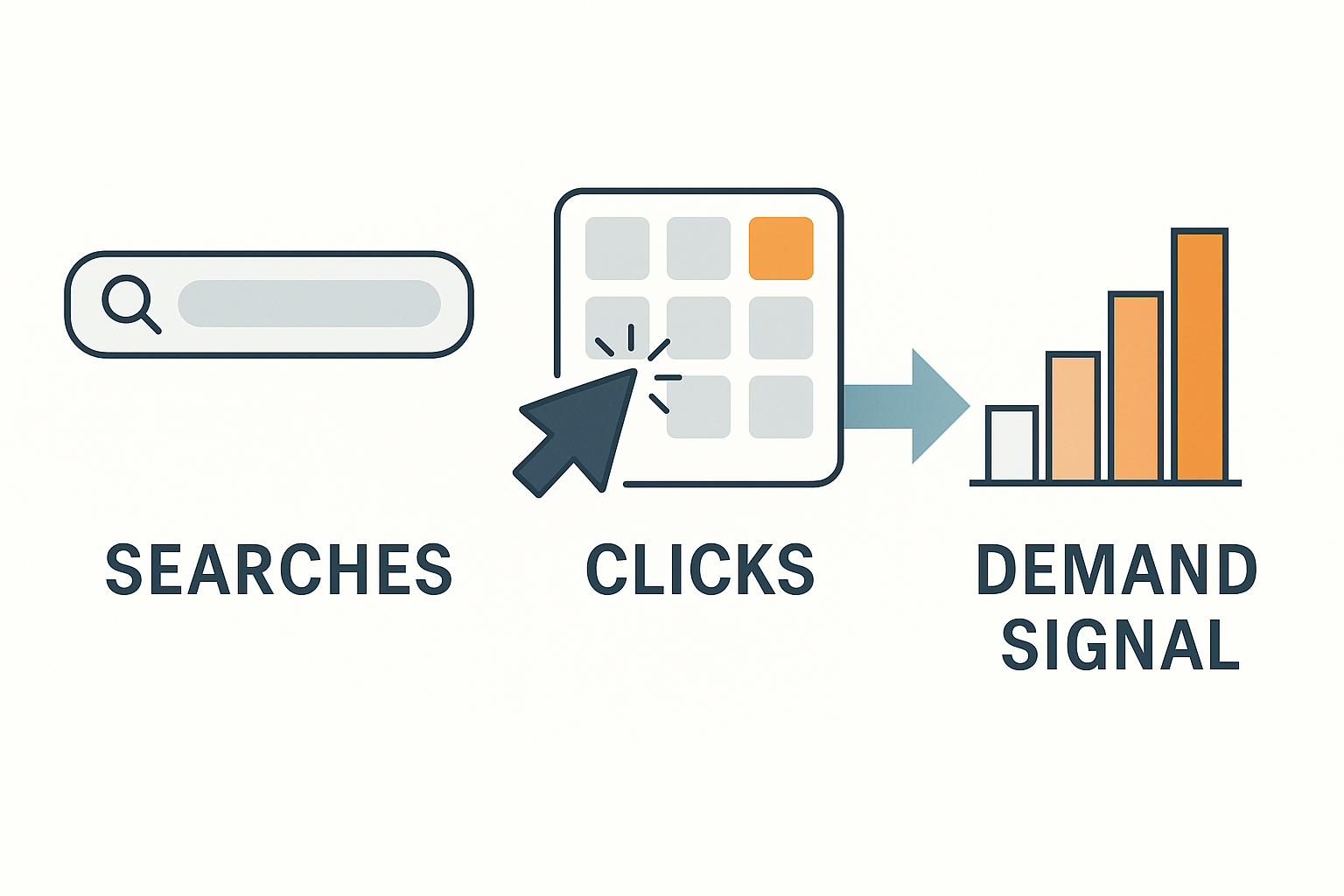
CP100 – Clicks per 100 Searches – was introduced to solve that problem.
Instead of asking what sold, CP100 asks a more important question:
When buyers search, do they actually engage?
What CP100 Means
CP100 stands for Clicks per 100 Searches.
It is a buyer-behavior metric that measures clicks per 100 searches on Amazon.
In simple terms:
CP100 shows how much real buyer interest exists behind a keyword.
A higher CP100 means buyers are actively engaging with search results.
A lower CP100 means searches exist, but intent is weak, scattered, or unfocused.
Why Search Volume Alone Is Misleading
Search volume tells you how often a term is searched – nothing more.
It does not tell you:
-
If buyers are serious
-
If listings are compelling
-
If demand is concentrated or diluted
-
If the niche is already exhausted
Many high-volume keywords are driven by:
-
Curiosity searches
-
Comparison behavior
-
Overcrowded listings
-
Poor differentiation
CP100 adds the missing context: engagement density.
CP100 vs Traditional Amazon Metrics
CP100 vs BSR
Best Seller Rank measures historical sales velocity.
It is:
-
Backward-looking
-
Influenced by ads and promotions
-
Blind to buyer intent before purchase
CP100 operates earlier in the funnel – at the moment buyers decide whether to engage.
CP100 vs Revenue Estimates
Revenue estimates reward past winners.
They do not reveal:
-
How hard demand is being fought over
-
Whether sales are ad-dependent
-
Whether demand is sustainable
CP100 isolates behavior, not outcomes.
A Simple CP100 Example
Consider two keywords:
Keyword A
-
10,000 searches
-
900 clicks
→ CP100 = 9
Keyword B
-
4,000 searches
-
1,200 clicks
→ CP100 = 30
Traditional tools prioritize Keyword A.
CP100 reveals that Keyword B has far stronger buyer intent, despite lower search volume.
This difference is often the line between:
-
A product that struggles
-
A product that scales
What CP100 Reveals About Buyer Behavior
CP100 provides insight into:
-
Buyer intent strength
-
Engagement quality
-
Competitive saturation
-
Demand concentration vs dilution
Low CP100 often indicates:
-
Too many similar listings
-
Weak differentiation
-
Browsing behavior
-
Demand exhaustion
High CP100 often signals:
-
Focused buyer intent
-
Clear demand
-
Opportunity for positioning or pricing advantage
How RockitSeller Uses CP100
RockitSeller treats CP100 as a core demand signal, not a standalone metric.
CP100 is used to:
-
Filter misleading high-volume keywords
-
Identify high-intent niches
-
Detect underserved demand pockets
-
Evaluate launch risk before capital is committed
-
Contextualize pricing and advertising decisions
CP100 is always combined with:
-
Competitive structure
-
Pricing dynamics
-
Buyer behavior trends
What CP100 Is – and Is Not
CP100 Is:
-
A demand-intensity metric
-
A buyer-behavior signal
-
A decision-support indicator
CP100 Is Not:
-
A revenue estimate
-
A ranking factor
-
A guarantee of success
-
A shortcut to product selection
CP100 does not replace analysis.
It improves it.
When CP100 Is Most Useful
CP100 is especially powerful when:
-
Evaluating new product opportunities
-
Comparing niches with similar revenue
-
Assessing buyer intent in saturated markets
-
Deciding whether ads will amplify or expose weakness
-
Avoiding “high-volume traps”
CP100 and the Shift to Demand Intelligence
CP100 represents a shift in how Amazon opportunity is evaluated.
From:
What sold before?
To:
How are buyers behaving right now?
This shift is foundational to RockitSeller’s approach to demand-first intelligence.
Final Thoughts
CP100 (Clicks per 100 Searches) measures what most sellers overlook: buyer engagement at the moment of search.
By focusing on intent rather than outcomes, CP100 helps sellers make better decisions about:
-
What to launch
-
How to price
-
When to advertise
Before costly mistakes are made.
RockitSeller applies CP100 alongside pricing, competition, and behavioral data to support smarter product research, pricing strategy, and advertising decisions.