
What Is Amazon Rufus and How Does It Actually Rank Your Listings?

Update, 28 September 2026. Amazon retired Rufus on 13 May 2026 and folded it into Alexa for Shopping. The name below is out of date. The mechanics mostly are not: the assistant moved into the search bar and became far more personalized, but nothing Amazon has published suggests the layer that reads your listing changed. That layer has a name and a published paper, and we wrote it up in how Amazon knows your product is for camping.
The short version. Amazon Rufus is Amazon’s AI shopping assistant. It reads your listing the way a well-read buyer would, then decides whether to surface your product, summarize it for a shopper, or skip it entirely. If your listing was written for the old Amazon search algorithm, Rufus is probably leaving money on the table.
I’m Tahir. I’m the founder of ListPilot. Before this I built and sold a parking software company called ParkingSoft. I’m not a copywriter. I’m an engineer who got obsessed with why good products with mediocre listings quietly bleed revenue month after month. Rufus turned that slow bleed into a faster one. This post is what I’ve learned so far.
What Is Amazon Rufus?
Amazon Rufus is a generative AI shopping assistant built into the Amazon app and website. Shoppers can ask it questions the way they’d ask a friend who happens to work at a store. Questions like “is this belt tough enough for a 2023 RZR 1000?”, or “what’s the difference between this and the one ranked below it?”, or “will this fit a crib that’s 52 inches wide?” Rufus answers using a mix of your listing content, your reviews, Q&As, and broader web data.
You can think of Rufus as a second layer sitting on top of Amazon search. The old layer, the A9 keyword-matching machine most sellers were taught to write for, is still there. But Rufus is increasingly the first thing a shopper interacts with. When a buyer asks a question, Rufus picks which products to recommend and how to describe them. If your listing doesn’t give Rufus the fuel to answer shopper questions clearly, you stop being part of the answer.
That is the game now.
How Amazon Rufus Works (From the Shopper’s Side)
A shopper opens the Amazon app and taps the sparkle icon. They type, “I need a durable drive belt for a Polaris RZR that I use for dunes.” Rufus doesn’t just return the top ten belts by sales rank. It reads the intent (durable, Polaris RZR, dunes) and pulls from listings that explicitly cover those signals. It might surface three options, summarize what’s different between them, and quote review themes like “holds up in high heat” or “slipped after 200 miles.”
A shopper who used to scroll twenty products and read ten reviews now gets a two-paragraph answer. The funnel compressed. That sounds like it’s good for shoppers and bad for sellers, but only if your listing isn’t the one Rufus picks.
How Rufus Ranks Your Listings (From the Seller’s Side)
Here’s the part most sellers haven’t internalized. Rufus is not choosing winners the way A9 did. A9 was a keyword-matching and conversion-rate machine. You stuffed your title with keywords, you got enough clicks and conversions, you ranked. Rufus is doing something different. It’s evaluating whether your listing can answer questions. It’s looking at whether your content covers the dimensions a shopper is likely to care about: fit, durability, use case, differentiators, what kind of buyer you’re for. I keep using one phrase. The algorithm rewards clarity. Not keyword density. Not spammy bullet points with pipes and caps. Clarity. Structured, specific, buyer-relevant information. This is why you can have a product that used to rank on page one, that hasn’t changed, and that is quietly sliding. Your listing didn’t get worse. The bar moved.
Rufus vs. the A9 Algorithm: What Actually Changed
The A9 era rewarded listings that were machine-readable in a narrow, mechanical way. Title stuffed with keywords. Bullets front-loaded with keywords. Backend search terms crammed to the character limit. The shopper experience was almost an afterthought. Rufus flips that. It rewards listings that are machine-readable in a richer way, and that read well to a human. If your bullets are pipe-separated keyword strings, Rufus struggles to use them to answer a shopper question. If your title is a 200-character soup of synonyms, Rufus can’t cleanly extract what the product actually is.
It’s not that keywords stopped mattering. It’s that keywords alone stopped being enough. You now need keywords and structured information and the kind of specifics that let an AI answer a buyer’s question without hallucinating.
I see this pattern over and over when we audit catalogs. Category leaders from 2022 and 2023, listings that are still making money on legacy sales velocity, score poorly when we grade them against what Rufus rewards. They’re not broken. They’re just not set up for the new layer.
The 8 Factors Rufus Rewards (Quick Preview)
When we built ListPilot, we needed a way to score a listing against Rufus-era expectations, not just A9. We landed on eight factors that, together, predict how well a listing performs under Rufus. I’ll walk through all eight in detail in the next post in this series, but here’s the shape of them. A listing’s Rufus-readiness comes down to how clearly it answers: what is this product, who is it for, what makes it different, how should it be used, and what do other buyers say about it. We break that into measurable factors. Things like Brand Positioning, Feature Density, Use Case Coverage, and Buyer Intent Matching. A listing can look great on the surface and still fail three of those factors. It usually does. If you want to see your own listing scored against all eight, you can run a free audit at the end of this post.
What This Means for a Real Listing
Let me show you what this actually looks like with numbers. One of the ASINs we use in demos is a Polaris RZR drive belt, a high-revenue part in the automotive vertical. When we first scored it, here’s what we saw.
Overall health score: 58 out of 100. Title score: 0. Images score: 70. Review sentiment score: 9%. Brand Positioning factor: POOR. Feature Density factor: POOR.
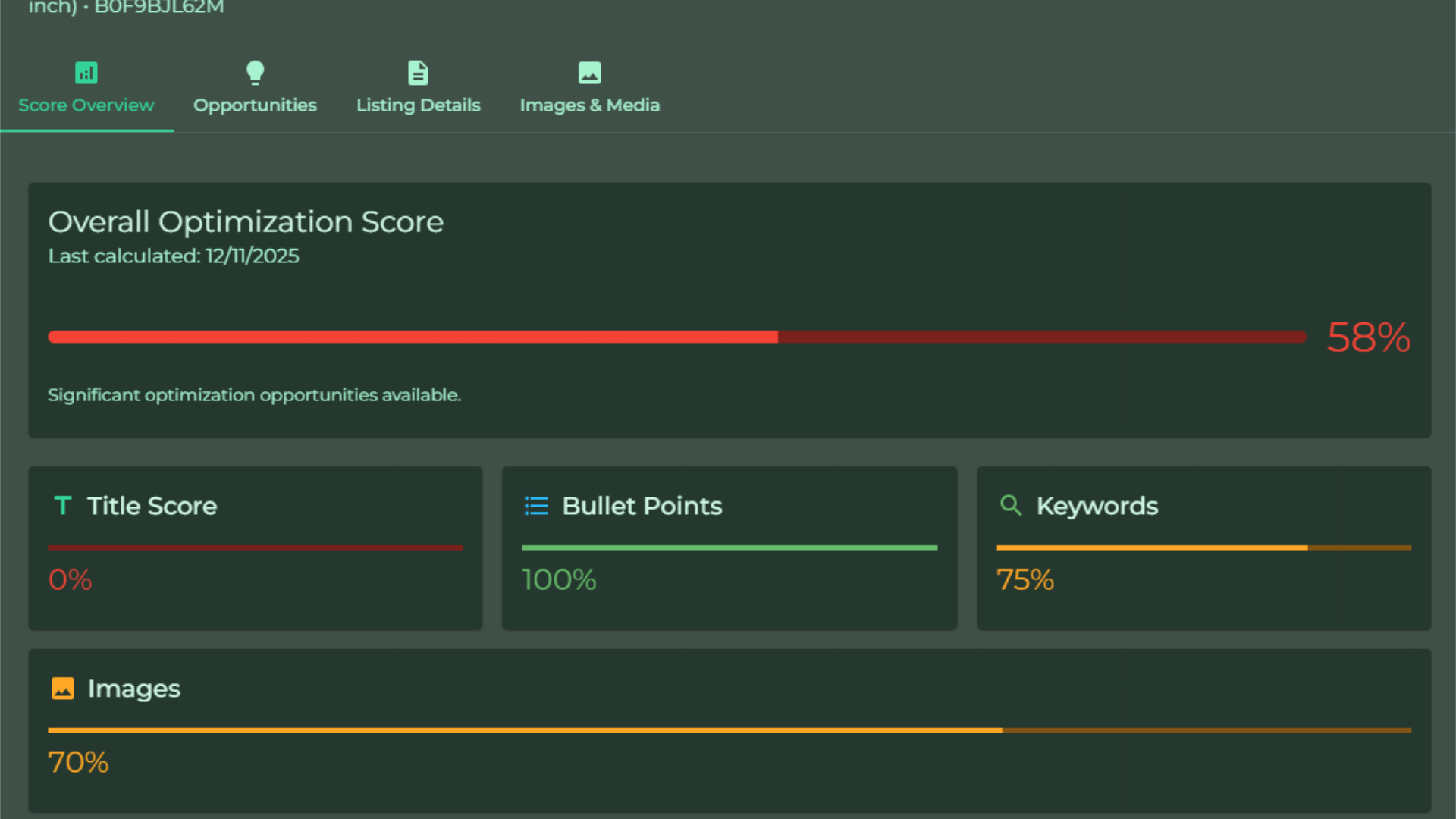
That listing was still making money. It was ranking. But two of the eight Rufus factors were failing outright. The title didn’t clearly establish the brand’s position in the category. The bullets were thin on the kind of specific, model-fit, performance-under-load information that Rufus uses to answer questions like “will this hold up in the dunes?”
We rewrote the title against the factors. One pass. The title score went from 0 to 91. Brand Positioning flipped from POOR to passing. Feature Density flipped from POOR to passing. The revenue leak, the estimated share of conversions the listing was losing by being fuzzy on those factors, became visible and quantifiable for the first time.
The product didn’t change. The photography didn’t change. The price didn’t change. The listing just became legible to Rufus.
That’s the shift.
Why Most Sellers Are Behind on This
Two reasons.
The first is that most listing advice on the internet is still A9 advice. “Put your keyword at the start of the title.” “Use pipes in your bullets.” “Stuff your backend search terms.” None of that is wrong per se. It’s just incomplete. Rufus doesn’t care about pipes. Rufus cares whether your listing actually describes the product.
The second is that Rufus rolled out fast, quietly, and in a way that doesn’t trigger alarms. A listing doesn’t go from page one to page five overnight. It just starts getting recommended less often in AI-generated answers. Your conversion rate drops a point or two. Your impressions dip without an obvious cause. The average seller notices six to twelve months later, when their quarterly numbers get ugly.
If you’re still selling, you’re probably running on listing work you did in 2023 or 2024. It’s worth asking whether that work holds up against what Rufus rewards now.
Your Next Move
If you’re reading this in 2026, here’s what I’d do in order.
First, pick your top three ASINs by revenue. Not your whole catalog. The ones where a 5% conversion-rate lift is a real number.
Second, grade them honestly against the eight Rufus factors. I walk through all eight in the next post. You can do this manually or you can use ListPilot’s audit to do it in about ninety seconds per ASIN.
Third, rewrite whichever factor is scoring worst. Don’t try to fix everything at once. Find the POOR, make it a pass, measure, move on. The title is usually where the biggest lift hides, which I cover specifically in Amazon Title Optimization.
Fourth, watch your revenue leak number. If the listing is ranking but leaking, the fix is usually on the convertability side (images, bullets, A+ content), not more keywords.
I’m writing this series because I think the sellers who adjust in the next six months are going to quietly pull ahead of the ones who don’t. Rufus isn’t a trend. It’s the new floor.
Get a Free ListPilot Audit of Your ASIN
Paste your listing into ListPilot and we’ll score it across all eight Rufus factors, surface your revenue leak, and show you exactly what to change. No credit card. No sales call.
Tahir Khan is the founder of ListPilot and previously the technical co-founder of ParkingSoft, a cloud-based parking software company acquired by T2Systems. He writes about Amazon listing optimization, AI-era ranking, and what seven-figure sellers are doing differently.