
When we first started building ListPilot, I kept running into the same question from sellers. “My listing was ranking fine a year ago. Nothing changed. Why is it sliding?”
The honest answer is that the bar moved. Amazon’s AI shopping assistant, Rufus, is now part of how shoppers find products, compare them, and decide. And Rufus doesn’t grade a listing the way the old A9 algorithm did. (If you haven’t read the explainer, start with What Is Amazon Rufus and How Does It Actually Rank Your Listings?.)
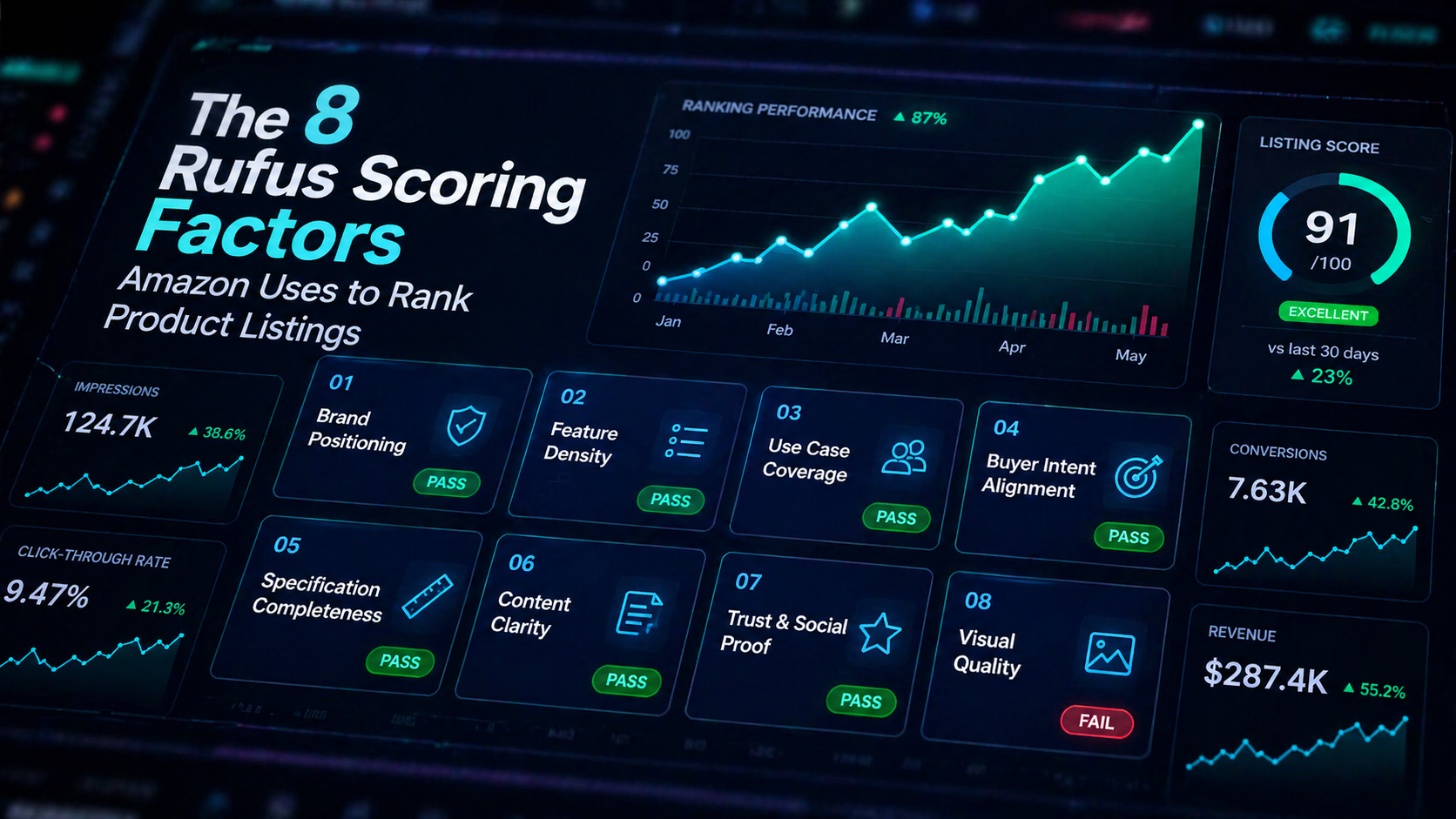
This post is about the eight factors we grade every listing against inside ListPilot. These are the factors that, in our audits, most predict whether a listing performs well in the Rufus era or quietly bleeds revenue in it.
Why These Eight
A listing has to do two jobs at once now. It has to be findable (Amazon surfaces it when a shopper searches) and it has to be answerable (Rufus can pull clean information from it when a shopper asks a question). The eight factors cover both jobs.
I’ll walk through each factor, what it means, why it matters, and how to tell if your listing is passing or failing on it. At the end I’ll show you what happens when you flip two of these from POOR to pass on a real ASIN. Spoiler: the title score jumps from 73 to 91 in a single rewrite.
Factor 1: Brand Positioning
What it is. Does your listing clearly establish what kind of brand you are in this category, and why a shopper should trust you over a no-name alternative?
Why it matters for Rufus. When a shopper asks “what’s a reliable brand for X?”, Rufus pulls from listings that signal positioning explicitly. Generic copy that could describe any brand in the category gets overlooked.
How to check. Read your title and first bullet out loud without the brand name. Could it be any brand in the category? If yes, you’re failing on Brand Positioning.
How it commonly fails. Brand name buried at the end of the title. No trust signals in the first 100 characters. Copy that sounds like a drop-shipper wrote it.
Factor 2: Feature Density
What it is. The ratio of specific, concrete features to marketing fluff in your listing content.
Why it matters for Rufus. Rufus uses specific features (size, material, compatibility, performance specs) to match products to shopper queries. Fluff is invisible to it.
How to check. Take your bullets. Count the concrete specs (numbers, measurements, materials, model fits) vs. adjectives (premium, superior, high-quality). If you have more adjectives than specs, you’re failing on Feature Density.
How it commonly fails. Bullets that lead with benefits (“Enjoy peace of mind”) and never get to the actual specification. Titles padded with adjectives that don’t help a shopper match the product to their need.
Factor 3: Use Case Coverage
What it is. Does your listing describe who the product is for, what they use it for, and in what scenarios?
Why it matters for Rufus. Shoppers ask Rufus questions in terms of their use case, not your features. “I need a belt for dunes.” “I need a monitor for photo editing.” Listings that name the use case get pulled into the answer.
How to check. Search your listing for the three to five real use cases your best customers actually have. If they’re not there by name, you’re failing on Use Case Coverage.
How it commonly fails. One-size-fits-all descriptions. Listings that describe the product in the abstract instead of in the hands of a specific buyer with a specific job to do.
Factor 4: Buyer Intent Alignment
What it is. Does your listing speak to the actual decision criteria your shopper is weighing?
Why it matters for Rufus. Rufus tries to match listings to intent. A shopper comparing two products isn’t asking about features, they’re asking about tradeoffs. If your listing doesn’t name the tradeoff, you’re not in the comparison.
How to check. List the top three questions a shopper asks before buying your product. Are all three answered in your listing copy? Usually only one is.
How it commonly fails. Listings written from the seller’s perspective (what we made) instead of the shopper’s (why you’d pick this over the alternative).
Factor 5: Specification Completeness
What it is. Are the dimensions, compatibility, materials, measurements, and fit data all present and clearly labeled?
Why it matters for Rufus. A shopper who asks “will this fit a 2020 RZR XP 1000?” is asking a spec question. If the spec isn’t in your listing, Rufus can’t confidently recommend you. It might skip you entirely rather than hallucinate.
How to check. Read your product details and bullets. Could a buyer figure out fit and sizing without asking a question? If any common question requires them to message you, you’re failing on Specification Completeness.
How it commonly fails. Vague compatibility (“fits most models”). Missing measurements. Dimensions only in the image but not in the text.
Factor 6: Answer-Readiness
What it is. Can Rufus pull clean, quotable phrases from your listing to answer a shopper’s question without paraphrasing or hallucinating?
Why it matters for Rufus. This is the factor most sellers haven’t thought about at all. Rufus is generating answers. It prefers to quote. If your copy is pipe-separated keyword soup, there’s nothing to quote.
How to check. Pick three common shopper questions. Now find the exact sentence in your listing that answers each one. If you can’t find a clean sentence, you’re failing on Answer-Readiness.
How it commonly fails. All-caps bullets. Pipe-separated feature lists. Copy that reads like a spec sheet but not like a sentence.
Factor 7: Review Signal Alignment
What it is. Do the claims in your listing line up with what your actual buyers say in their reviews?
Why it matters for Rufus. Rufus blends listing content with review themes. If your listing claims “quiet operation” but reviews mention noise, Rufus weights the reviews more heavily and your claim becomes a liability. If your listing doesn’t claim something your reviews praise, you’re leaving a selling point on the table.
How to check. Read your last fifty reviews and extract the themes. Now check your listing. Are the positive themes claimed? Are the negative themes addressed (or at least not contradicted)?
How it commonly fails. Listings written before the product had 100+ reviews, never updated. Claims that are technically true but that reviews consistently push back on.
Factor 8: Visual-Textual Coherence
What it is. Do your images reinforce the text, and does your text reinforce the images?
Why it matters for Rufus. Rufus processes both text and image captions, and it notices contradictions. A title that claims one feature while the main image shows something else creates friction. Worse, it degrades buyer trust during the click-through.
How to check. Scroll your listing with text hidden and see which claims come through visually. Then scroll with images hidden and see which claims come through in text. The Venn diagram should be close to a circle.
How it commonly fails. Stock-looking main image. Infographic images that repeat claims not backed up in the bullets. A+ content that tells a different story than the detail page.
What Happens When You Fix Two of These
Here’s what the factors look like in practice. We audit a Polaris RZR drive belt listing in the automotive category. The listing is already making real money. Here’s what we find.
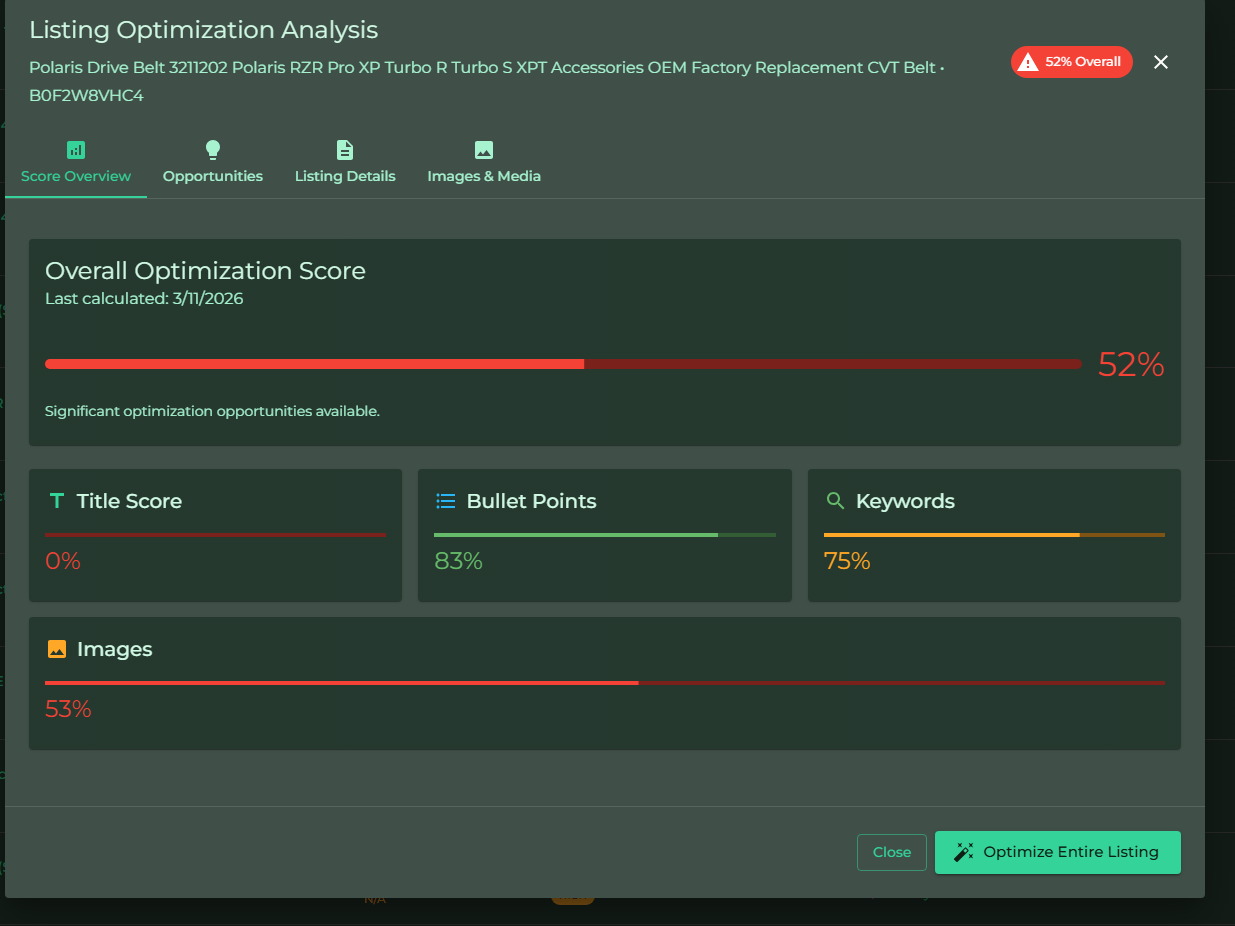
We rewrite the title. Just the title. We work on the two failing factors: we reposition the brand at the front of the title with a category claim, and we swap three of the adjective-heavy phrases for concrete performance specs and fit information.
The product didn’t change. The photos didn’t change. The price didn’t change. We just made the listing legible to Rufus.
How to Use This Framework
I’d use these eight factors in order of priority for most sellers.
Start with Factor 1 (Brand Positioning) and Factor 2 (Feature Density). These are where the biggest and fastest lifts usually hide, because they’re often where listings that were written in the A9 era are weakest. I cover the specific mechanics of this in Amazon Title Optimization and Amazon Bullet Points Best Practices.
Then move to Factors 3 through 6 (Use Case Coverage, Buyer Intent Alignment, Specification Completeness, Answer-Readiness). These are the ones that separate good listings from great ones in the Rufus era.
Factors 7 and 8 (Review Signal Alignment and Visual-Textual Coherence) are often already in reasonable shape, but worth a quick audit. If they’re off, they’re expensive to fix, so you want to know.
For the full optimization process, read How to Optimize Amazon Listings for Rufus in 2026.
Get a Free ListPilot Audit of Your ASIN
Paste your listing into ListPilot and we’ll score it across all eight Rufus factors, surface your revenue leak, and show you exactly what to change. No credit card. No sales call.
Tahir Khan is the founder of ListPilot and previously the technical co-founder of ParkingSoft, a cloud-based parking software company acquired by T2Systems. He writes about Amazon listing optimization, AI-era ranking, and what seven-figure sellers are doing differently.
About
RockitSeller makes software for Amazon sellers who are done guessing – starting with ListPilot, which scores any listing against the signals that correlate strongest with how Amazon ranks today and rewrites what’s costing you sales.
Contact
+1(770) 857-3352
support@rockitseller.com