
Do I need to rewrite my listings for Alexa for Shopping?
Short answer: almost certainly not, and not for the reasons you are being told to.
Amazon retired Rufus on 13 May 2026 and folded it into Alexa for Shopping. Within days there was a fresh wave of guides explaining how to optimize your listings for it. Read a few of them side by side and you will notice the same advice that was being sold for Rufus six months earlier, under a new heading.
There is one real change buried under all of that, though, and it is not a copywriting change. It is an advertising change, and it quietly makes your detail page into ad copy you do not write.
What actually changed
Worth separating what Amazon announced from what the industry inferred.
Amazon’s own announcement says Alexa for Shopping brings Rufus and Alexa+ together, and that it is available to all U.S. customers on the Amazon Shopping app and website plus Echo Show, with no Prime membership or Echo device required. Amazon says Rufus “helped over 300 million customers in 2025 research, compare, and buy products.”
The concrete differences, from Amazon’s description:
- It sits in the main search bar. You no longer open a separate panel. You ask in the box you were already typing in.
- It is personalized far more aggressively. It draws on “your personal preferences, shopping history, and conversations from across both Amazon.com and Alexa.” Two shoppers can ask the same question and get different answers.
- It does more than answer. Shopping guides for big purchases, dynamic product comparisons, up to a year of price history, automated deal-finding and cart-building.
Those are real changes to how shoppers behave. The personalization one in particular is a genuine shift, because it means there is no single correct answer to “where do I rank in the assistant” any more. There never really was, but now there provably is not.
What did not change
Nothing Amazon published says the layer that reads your listing changed.
That layer has a name and a paper. It is called COSMO, and it is the system that infers what your product is for, which is why a search for “water bottle for camping” returns products whose listings never use the word camping. We wrote that up in how Amazon knows your product is for camping when you never said so.
The assistant is a surface. COSMO is underneath it. Amazon replaced the surface and, as far as any public statement goes, left the thing underneath alone.
This is the part I would like sellers to sit with, because it is checkable and it settles an argument. For two years the advice industry told everyone to optimize for Rufus. Then Rufus stopped existing. If your listing work was genuinely aimed at Rufus, it would now need redoing. It does not, and nobody is seriously claiming it does, which is itself the admission that Rufus was never the thing being optimized for.
So the honest answer to “do I need to rewrite my listings” is: only if they were bad before. The title and bullet work that mattered in April matters in September for the same reasons. Our title format guide and the piece on writing bullets for the assistant rather than only for buyers both still apply, unchanged, which is the most useful thing I can tell you about them.
The change that does affect you, and it is not about copy
Here is the part almost nobody leads with.
Since 25 March 2026, Sponsored Products and Sponsored Brands placements inside the assistant’s answers, called Sponsored Prompts, have been billable on standard CPC. They ran free from around November 2025, then exited beta. Eligible campaigns were enrolled automatically. There was nothing to opt into and, as far as I can find, nothing to opt out of separately.
Two consequences follow, and they are different in kind.
One: you are already paying for a placement you probably have not looked at. If you run Sponsored Products, some fraction of your spend is now going to clicks inside AI-generated answers. Trade estimates put it in the low single digits of Sponsored Products spend, which on a large account is real money and on a small one is a rounding error. Either way, check it before you have an opinion about it, because it is going out whether you formed one or not. If you are unsure what a click is worth to you in the first place, that is the arithmetic in how to tell whether your PPC is profitable.
Two, and this is the interesting one: Amazon writes that ad copy, from your listing. It synthesizes the recommendation text from your own first-party content, your detail page, your Brand Store, your reviews. You do not write the sentence a shopper reads.
Think about what that does to the relationship between your listing and your advertising. In a Sponsored Products placement, your listing is what the shopper lands on. In a Sponsored Prompt, your listing is the source material for the pitch itself. A vague bullet is no longer just a weak bullet on a page someone might scroll past. It is the raw input to a sentence Amazon will generate and charge you for.
That is a genuinely new reason to care about listing specificity, and it has nothing to do with writing conversationally or sprinkling in question phrases. It is the boring version: if the source says something concrete and true, the generated pitch can be concrete and true. If the source hedges, the pitch hedges.
How you would actually know
Badly, is the honest answer.
As far as I can tell there is no Alexa for Shopping line anywhere in Business Reports, and Amazon has not announced one. There is no way to ask “how many of my sessions came through the assistant.” So anyone showing you a number for assistant-driven traffic has built it out of proxies, and you should ask which ones.
What you can actually do:
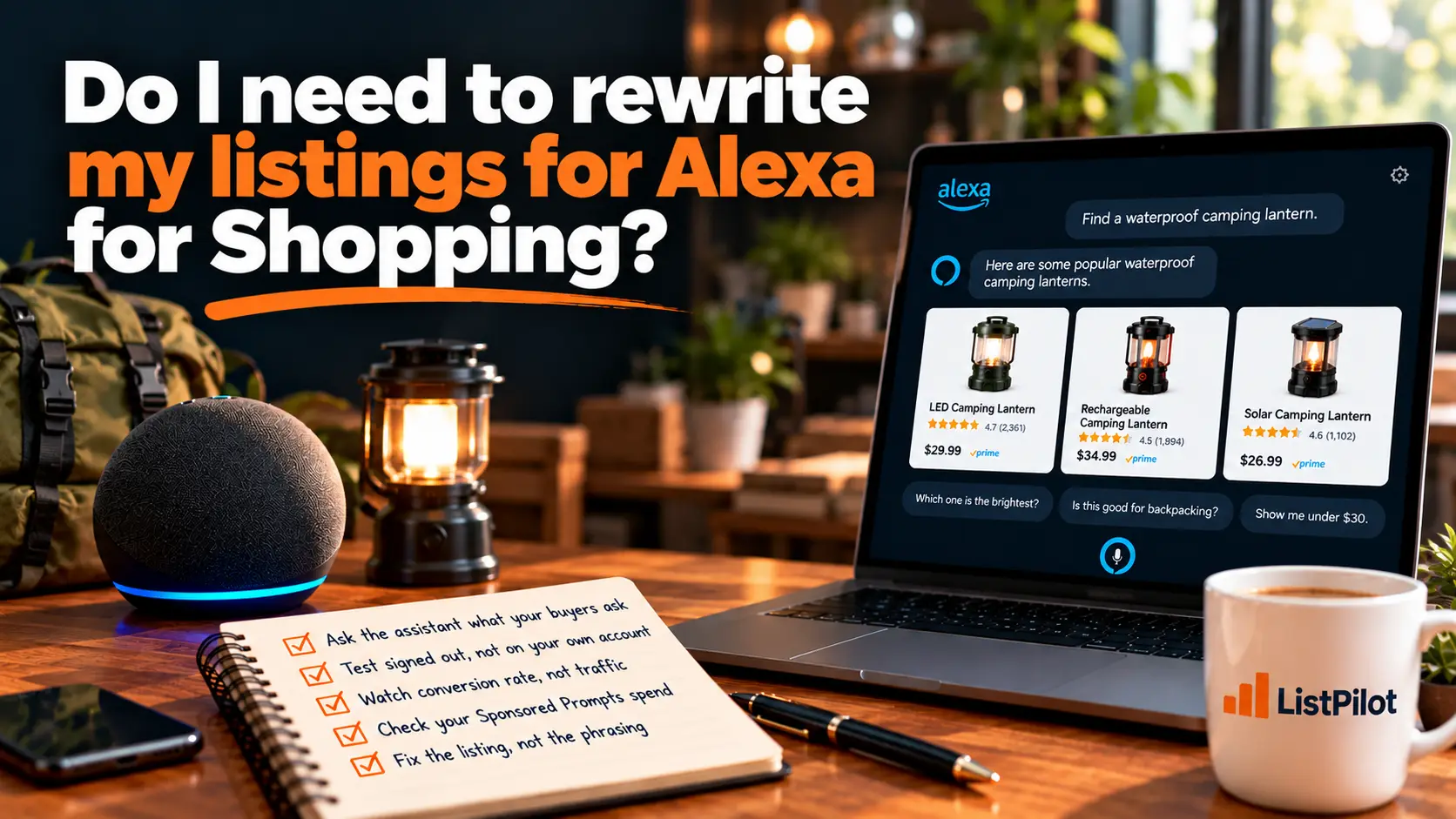
- Ask the assistant the questions your buyers ask and see whether you come up. Do it signed out or in a fresh session, because the personalization means your own account is a contaminated test.
- Watch conversion rate rather than traffic. If the assistant is sending people who have already had their questions answered, they should convert better, not worse.
- Look at your Sponsored Prompts spend specifically, since that is the one part of this with real reporting attached to it.
None of that is measurement. It is checking. Worth knowing the difference before building a strategy on it.
Where I am inferring and where I am not
Verifiable: the 13 May 2026 retirement, the surfaces and availability, the 300 million figure, and the 25 March billability change. Those come from Amazon’s own announcement and from trade reporting on the ads change, and you can go and read both.
Inferred: that COSMO is unchanged. Amazon announced a new assistant, not a new ranking system, and said nothing about COSMO either way. Absence of an announcement is weak evidence, and I would rather say so than dress it up. It is the evidence there is, and the alternative reading, that Amazon quietly rebuilt its intent-inference layer in the same release and mentioned it to nobody, is the less likely of the two.
Also inferred: how much of your Sponsored Products spend is going to prompts. The low-single-digit figure is a third-party estimate across other people’s accounts, not a number from Amazon, and yours will differ. Go and look at yours.
The useful takeaway
Assistants are surfaces and surfaces get replaced. Rufus had a name for two years and then it did not. The layer that decides whether Amazon thinks your product fits what a shopper wants is older, quieter, and has a published paper behind it, and it survived the rename without comment.
Write for that. It is the same work either way, which is the point.
I should put my interest on the table: I build ListPilot, which scores listings on whether the intents a product serves come through clearly rather than whether the right keywords are present. Nothing about it changed in May either, for the reasons above.
Want to see what a machine reads in your listing? Run a free audit on one of your ASINs and see which customer intents come through clearly and which ones do not.
Sources: Amazon’s announcement of Alexa for Shopping for the launch, surfaces, availability and the 300 million figure. Trade reporting for the 25 March 2026 Sponsored Prompts billability change. COSMO details from Yu et al., SIGMOD 2024, available at amazon.science. Inferences are labeled above.