
How does Amazon know my product is for camping if I never said so?
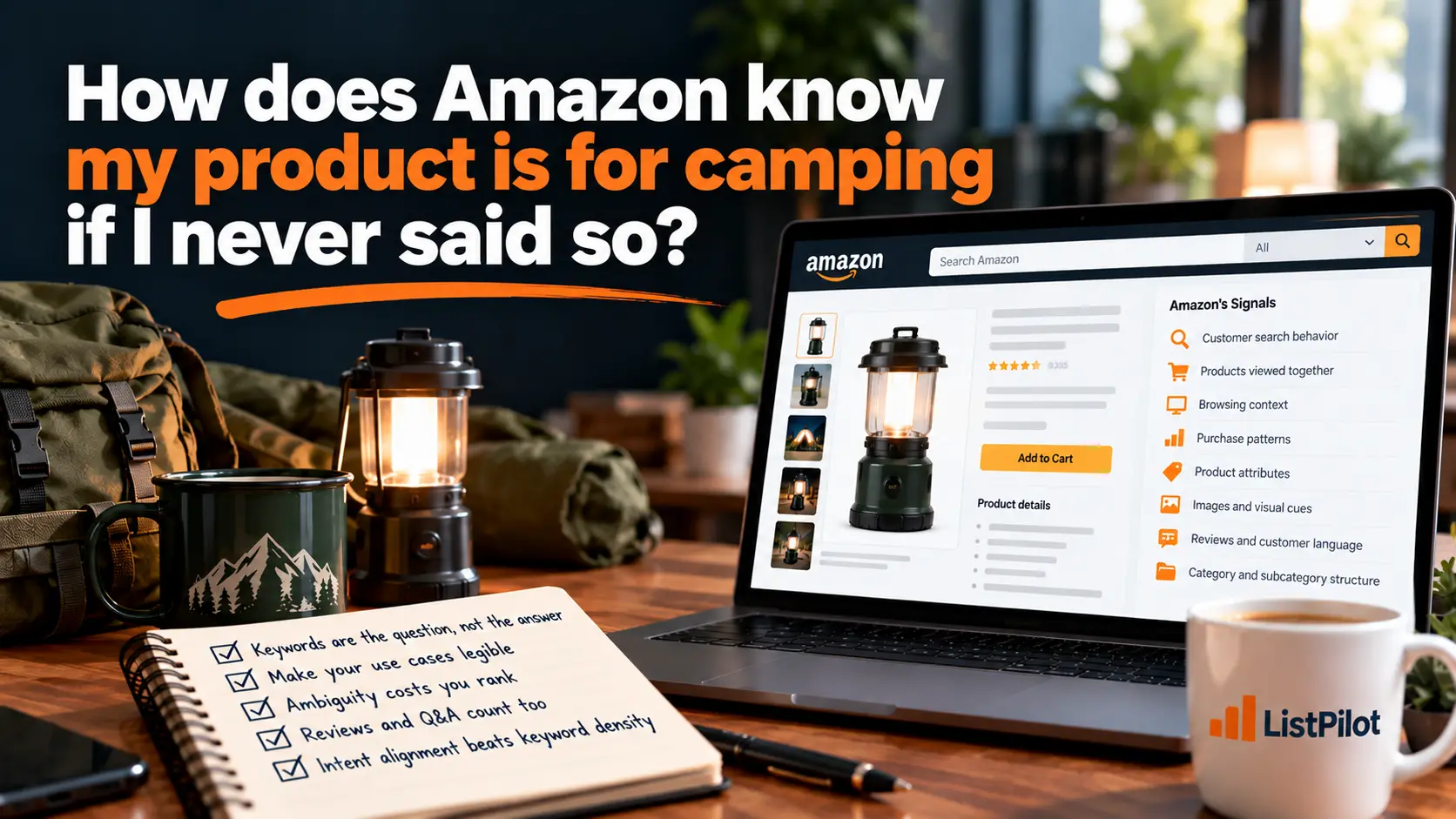
Search Amazon for “water bottle for camping” and you will find products whose listings never use the word camping. Search for “shoes for a wedding” and you get formal shoes, not trainers, even from sellers who never wrote the word wedding anywhere.
Something is deciding what your product is for, and it is not reading your keywords the way the old system did.
That something is called COSMO, and Amazon has published a paper describing it. Most of what gets written about ranking in 2026 is aimed one layer above it, which is why so much of the advice does not work.
The short version
The assistant is not what ranks your products. COSMO is.
Amazon retired Rufus on 13 May 2026 and folded it into Alexa for Shopping. The assistant in the search bar has a new name, a new surface, and a great deal more personal history about the shopper. COSMO, as far as anything Amazon has published tells us, did not change.
That is the cleanest evidence available for the argument this post makes. The assistant is a surface. COSMO is the system underneath, doing the work of figuring out what a shopper actually wants. Amazon replaced the surface, and the layer that decides whether your product fits a shopper’s intent carried straight on.
So when people said “optimize your listing for Rufus,” and now say “optimize for Alexa for Shopping,” what they mean, whether they realize it or not, is “make your listing legible to COSMO.”
Those are two different problems with two different answers. Optimize for the wrong one and you end up with copy that reads beautifully when an assistant says it out loud, and does nothing for your position in search results.
What COSMO actually is
COSMO is Amazon’s common-sense knowledge generation system, published at SIGMOD 2024 and available in full on amazon.science. The name is doing real work: the point of building it was to move past what did the shopper do and into why did they do it.
For two decades Amazon’s ranking learned from observed behavior. Clicks, purchases, queries, dwell time. That works, but it has a ceiling. Observed behavior gives you correlation. It does not give you reasoning.
COSMO is Amazon trying to break through that ceiling by inferring the intent underneath the behavior. Why is this person searching for a kids water bottle? A gift? Replacing one lost at camp? Outfitting a classroom? Something a toddler cannot pop the lid off? The behavior alone does not tell you. The intent does.
The scale is worth sitting with. The knowledge graph runs to roughly 6.3 million nodes and 29 million knowledge edges across 18 product categories, built out from around 30,000 human-refined labels and applied as inference across millions of ASINs.
Thirty thousand is a small number next to Amazon’s catalog. Which tells you the labeled set will keep growing, and the inference quality will compound with it. What COSMO can do today is not what it will be doing in eighteen months.
Keywords did not stop mattering. They changed jobs.
This is the part most sellers have not absorbed.
The dimensions COSMO reasons across are linguistic. Keywords, and the patterns in how keywords co-occur, are the raw material it uses to infer why a shopper is searching.
Under the old system, keywords were matching tokens. You stuffed them into your title because the system was looking for literal overlap with the query. Under COSMO they still matter, but for a different reason entirely.
Keywords used to be the answer the system gave back. Now they are the question the system asks itself about your listing.
That is why keyword density stopped carrying the weight it used to, and why a listing can contain every relevant term and still lose to one that contains fewer.
Where the assistant fits
Here is the working model, and I want to flag clearly that this part is inference. Amazon never published the full architecture of Rufus, and has not published Alexa for Shopping’s either. I am reasoning from the COSMO paper plus how systems like this usually get built.
There are two surfaces a shopper touches.
The search bar, where almost all actual shopping still happens. A query goes in, an ordered list comes back, someone clicks. COSMO influences that order, sorting candidates by how well each listing maps to what it believes the shopper wants. Influencing the order is, functionally, ranking. The assistant is not in this loop. By the time it appears, the order has already been decided.
The assistant itself, the conversational answer a shopper gets to an open-ended question. It parses the natural language, draws on systems including COSMO, and writes back a recommendation in prose. Different surface, different output, overlapping but not identical signals.
Two things genuinely changed in May 2026, and neither one is that loop. Alexa for Shopping moved the assistant into the main search bar rather than a panel you open, and it brought Alexa+ personalization with it, so the same question from two shoppers can now return different answers depending on their own purchase history. Both are real changes to the experience. Neither is a change to how your listing gets read.
The implication is the part that should land. The thing you care about, your position when someone searches, gets decided on the first surface. COSMO shapes that decision. The assistant is downstream of it.
The assistant is a surface. COSMO is the brain. If you want the longer version of how the assistant behaves, we wrote that up separately in what Amazon Rufus is and how it ranks your listings, written while Rufus still had its own name. There is a newer piece on whether Alexa for Shopping changes what you should do.
What this means for your listing
If COSMO is reasoning about intent from language patterns, a listing that ranks is one COSMO can read with confidence. Four things follow.
Intent alignment beats keyword density. The old game was cramming every plausibly relevant term into the title and bullets. The new one is structuring copy so the terms cluster in a way that maps cleanly onto the intents your product actually serves. You can hold every right keyword and still lose if their arrangement leaves the system unsure what the product is for.
Your use cases have to be readable as structure, not flourish. If your product genuinely serves three customer needs, all three should be legible to something reasoning about intent. Our title format guide and the piece on writing bullets for Rufus rather than only for buyers both come at this from the copy side.
Ambiguity costs you. Listings that hedge across unrelated use cases, or pad with generic adjectives, give the inference layer less to work with. Specificity lets the model commit. Vagueness leaves it stuck, and a system that cannot decide what your product is for will not confidently place it against an intent.
Reviews and Q&A are part of the surface. COSMO reasons over more than your title and bullets. The language around your product, what reviewers say, what questions keep coming up, is part of the landscape it reads.
Where this is inference and not fact
Reading a public paper and extrapolating to production behavior carries real risk, so here is the line.
The COSMO paper describes the knowledge generation system. It does not fully describe how COSMO’s outputs feed into search ranking weights. Amazon is certainly using a stack of signals well beyond it: price, conversion rate, fulfillment, review velocity, ad spend, the long list. So when I say COSMO is what ranks you, that is shorthand for “COSMO’s intent representations have become a heavily weighted input into a ranking stack with many inputs.”
The assistant architecture above is inferred from how retrieval-style assistants usually get built, plus what Amazon has said publicly. Anyone telling you they know exactly how Alexa for Shopping and COSMO interact is either an Amazon engineer under NDA or guessing.
The claim that May’s rename left the ranking layer untouched is also an inference, and I want it labeled as one. What Amazon announced was a new assistant, not a new ranking system, and it said nothing about COSMO either way. Absence of an announcement is weak evidence. It is the evidence there is.
One more, and it is the observation I would most like to be right about: if you have used Product Opportunity Explorer, you will have seen a Customer Need field next to each niche. I believe that is COSMO surfacing into a tool sellers can actually look at, which would make it one of the few places its reasoning is visible to us. Amazon has not confirmed that, so treat it as a strong hunch rather than a fact, but it is worth going and looking at either way.
Treat all of this as a working model. It is the most coherent one I have been able to build out of the public material, and I think it is actionable. It is not gospel.
Why this is worth your attention
I should put my interest on the table: I build ListPilot, which scores listings on exactly this reasoning, measuring whether the intents a product serves are legible rather than whether the keywords are present.
But the reason to understand COSMO has very little to do with any tool. Watch what happened in May. The assistant got a new name, and within days the advice industry produced a fresh wave of “how to optimize for Alexa for Shopping” material describing the same listing practices under a new heading. That is what optimizing for a surface looks like from the outside. The surface can be renamed out from under you, and then the work you did for it has to be renamed too.
Knowing what the system underneath is actually doing will make you a better seller in 2026 than chasing whichever assistant is currently on the front page.
If you have read the paper and think something here is wrong, say so. The point of writing a working model down is to give people something specific to push against.
Want to see what a machine reads in your listing? Run a free audit on one of your ASINs and see which customer intents come through clearly and which ones do not.
Sources: Yu et al., “COSMO: A Large-Scale E-commerce Common Sense Knowledge Generation and Serving System at Amazon,” SIGMOD 2024, available at amazon.science. Amazon’s own announcement of Alexa for Shopping is the source for the May 2026 change. Architectural inferences are mine.