
Amazon Title Optimization: The Format That Ranks in 2026
Update, 28 September 2026. This post refers to “the Rufus era.” Amazon retired Rufus on 13 May 2026 and folded it into Alexa for Shopping. The format below is unchanged, because it was never built for the assistant’s name. It was built for the layer underneath, which did not change.
If you only fix one thing on your Amazon listing this quarter, fix the title.
I know that sounds like overblown advice. It isn’t. In the hundreds of catalog audits we’ve run at ListPilot, the title is the single piece of content where the gap between “what the listing does today” and “what the listing could do” is widest. It’s also the cheapest thing to fix. One Seller Central edit. No photographer, no designer, no brand meeting.
This post is the exact format we use to rewrite titles for seven-figure catalogs in 2026. It’s built for the Rufus era, which means it’s built for two readers at once: Amazon’s AI and the actual human shopper. Get the format right and both of them pick you up.
If you want the upstream context, start with What Is Amazon Rufus and The 8 Rufus Scoring Factors. Otherwise, let’s go.
Why Titles Matter More Than Ever
The title is doing more work in 2026 than it was doing in 2023.
In the old A9 world, the title was one input among many. Backend search terms, bullets, description, and review velocity all contributed to ranking. The title was important but it wasn’t decisive.
In the Rufus world, the title is often the single piece of text Rufus uses to decide whether to include your product in a recommendation. When a shopper asks Rufus “what’s a durable drive belt for a Polaris RZR?”, Rufus scans titles first to filter candidates. Your bullets don’t save you if your title doesn’t land.
This is also true on the shopper side. Click-through rate from search results is overwhelmingly driven by the title and main image. The two-second decision a shopper makes in a scroll is mostly a title decision.
Title work is the highest-leverage optimization on the listing. That’s the thesis.
The Anatomy of a Rufus-Ready Title
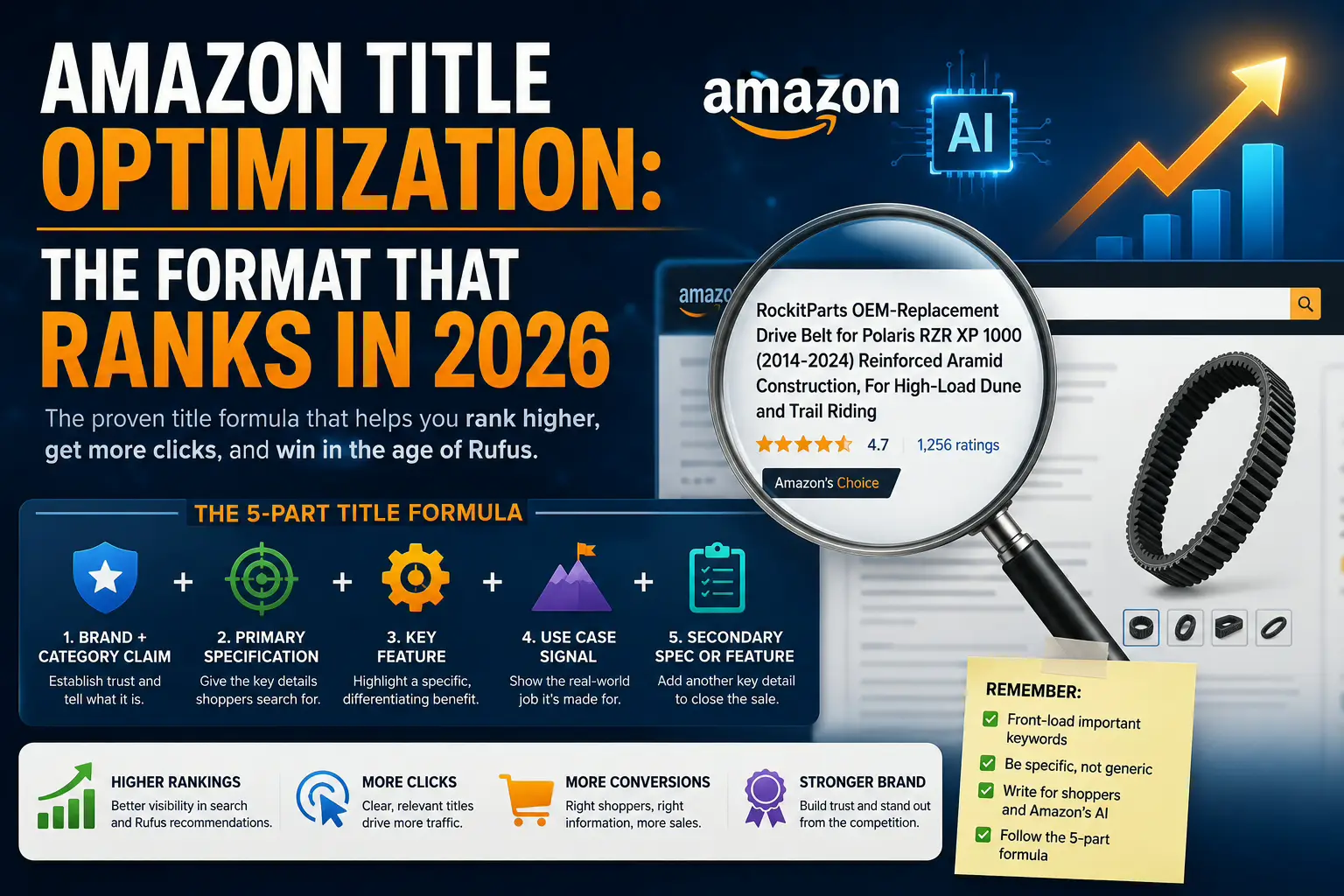
A title that performs in 2026 has five components in a specific order. The order matters because Rufus and A9 both parse from left to right, and early tokens carry more weight than late ones.
Component 1: Brand + Category Claim. Open with your brand, followed by a three-to-six-word claim about what kind of product this is and who it’s for. Not a generic category like “Drive Belt.” Something like “Heavy-Duty OEM-Replacement Drive Belt.” This is where Brand Positioning lives. It’s also the single most common failure point I see.
Component 2: Primary Specification. Immediately after the brand-and-category claim, put the spec a shopper needs to know to confirm this is the right product. For auto parts, that’s fit: model, year, trim. For apparel, that’s size and cut. For electronics, that’s the model or standard. The primary spec is the filter a buyer is mentally applying while they scroll.
Component 3: Key Feature. One concrete, non-obvious feature that differentiates this product from the alternative the shopper is comparing you against. Not an adjective. A fact. Materials, construction, capacity, certification, compatibility.
Component 4: Use Case Signal. The specific real-world job this product is used for, by name. “For Dune Riding.” “For Studio Monitoring.” “For Newborn 0-3 Months.” This is how Rufus maps shopper intent to your listing.
Component 5: Secondary Specification or Second Feature. If you have characters left, add a second disambiguating spec (size, color, capacity, count). This is the tie-breaker when a shopper is comparing two of your variants.
Put it together in one sentence: Brand + Category Claim + Primary Spec + Key Feature + Use Case + Secondary Spec. That’s the format.
What This Looks Like in Practice
Let me show you the format on a real ASIN.
Before (the original title, score 73):
Premium Drive Belt for Polaris RZR 1000 High Performance Replacement Part Durable Rubber Construction Heavy Duty
Read that out loud. It’s a string of adjectives and vague claims. “Premium.” “High Performance.” “Durable.” “Heavy Duty.” There’s no brand. There’s no specific model year. There’s no use case. A shopper asking “will this fit my 2022 XP 1000 I ride in the dunes?” can’t get a clean yes from this title, and neither can Rufus.
After (rewritten against the format, score 91):
RockitParts OEM-Replacement Drive Belt for Polaris RZR XP 1000 (2014-2024) Reinforced Aramid Construction, For High-Load Dune and Trail Riding
Same product. Same price. Same photos. Different title.
Watch what changed. Brand opens the title (“RockitParts”). Category claim is specific and positions the brand (“OEM-Replacement Drive Belt”). Primary spec is model and year range (“Polaris RZR XP 1000, 2014-2024”). Key feature is a concrete material claim (“Reinforced Aramid Construction”). Use case is named explicitly (“High-Load Dune and Trail Riding”)
The title score went from 73 to 91. Two Rufus factors flipped from POOR to pass. The revenue leak, which had been hidden, became visible as a quantifiable number. One edit. Thirty minutes of work.
The Five Most Common Title Mistakes
Every audit I’ve run flags at least one of these on the title. Most flag three or four.
Mistake 1: Adjective Soup. Premium, ultra, superior, heavy-duty, high-performance, professional. None of these words mean anything specific. Rufus ignores them. Shoppers glaze over them. Each one you remove frees a character for something that actually matches intent.
Mistake 2: Brand Buried at the End. A common pattern is keyword-keyword-keyword, then brand name. This costs you on Brand Positioning every time. Brand goes first, always. If your brand is new, pair it with a category claim that does trust work on its own.
Mistake 3: No Use Case Signal. A title that describes the product without naming what it’s for cedes the use-case-driven Rufus queries to competitors. Even when a product has one dominant use case, most sellers don’t name it.
Mistake 4: Keyword Stuffing Past the First 80 Characters. Mobile truncates your title around 80 characters. Everything after that is still indexed, but it’s invisible to most of your actual shoppers. Front-load the five components into the first 80 characters if you possibly can.
Mistake 5: Pipe or Dash Separators Instead of Natural Prose. Pipes, slashes, and long dashes signal keyword-dump to Rufus. Use commas and natural English. The title should read like a sentence, not a boolean query.
The 10-Minute Title Audit
Take your title and run it through this checklist.
First, is your brand the first word? If no, rewrite the open.
Second, does the second phrase positively claim what kind of product this is in specific category terms? Not “Drive Belt” but “OEM-Replacement Drive Belt.” Not “Crib” but “Convertible 3-in-1 Crib.” If no, rewrite.
Third, within the first 80 characters, can a shopper confirm fit or sizing? If the answer is ambiguous, add the primary spec.
Fourth, is there at least one concrete feature (not an adjective) in the title? If every differentiator is an adjective, swap two adjectives for specifications.
Fifth, is there a named use case in the title? If the product serves one obvious job, name it.
If four of five pass, you’re in the top quartile of titles in your category. If three or fewer pass, your title is probably the reason a listing that used to rank is now sliding.
What to Do After the Title
Fix the title first, let it breathe 14 days, and watch impressions and click-through rate. If both lift, the title fix worked. If impressions lift but conversion doesn’t, the title’s bringing in traffic that your bullets and images aren’t closing. That’s your signal to move to Amazon Bullet Points Best Practices next.
If impressions don’t lift at all, it’s likely that your title isn’t actually the weakest factor on the listing. Re-score against the eight Rufus factors and look for something more fundamental like Specification Completeness or Visual-Textual Coherence.
If conversion and impressions both dropped, you probably over-stripped the keywords. This is rare but worth flagging. Titles need to be readable and contain the keyword surface area. Rare balance, but necessary.
The Small Thing That Makes This Easier
Title rewrites done by hand work. I’ve done hundreds of them with a spreadsheet and a coffee.
What makes them slow is scoring and attribution. You rewrite the title, but without a factor scorecard, you don’t know whether you moved the needle on Brand Positioning or just shuffled the words around. That’s what ListPilot does. You paste the title in, it scores the eight factors, you rewrite, it re-scores, you see the delta.
You don’t need the tool to do the work. The tool just tells you whether the work landed.
Get a Free ListPilot Audit of Your ASIN
Paste your listing into ListPilot and we’ll score your title across all eight Rufus factors, surface your revenue leak, and show you exactly what to change. No credit card. No sales call.
Tahir Khan is the founder of ListPilot and previously the technical co-founder of ParkingSoft, a cloud-based parking software company acquired by T2Systems. He writes about Amazon listing optimization, AI-era ranking, and what seven-figure sellers are doing differently.
About
RockitSeller makes software for Amazon sellers who are done guessing - starting with ListPilot, which scores any listing against the signals that correlate strongest with how Amazon ranks today and rewrites what’s costing you sales.
facebook X instagram linkedin youtube
Contact
+1(770) 857-3352
Policies