
Amazon Bullet Points: Writing for Rufus, Not Just Buyers
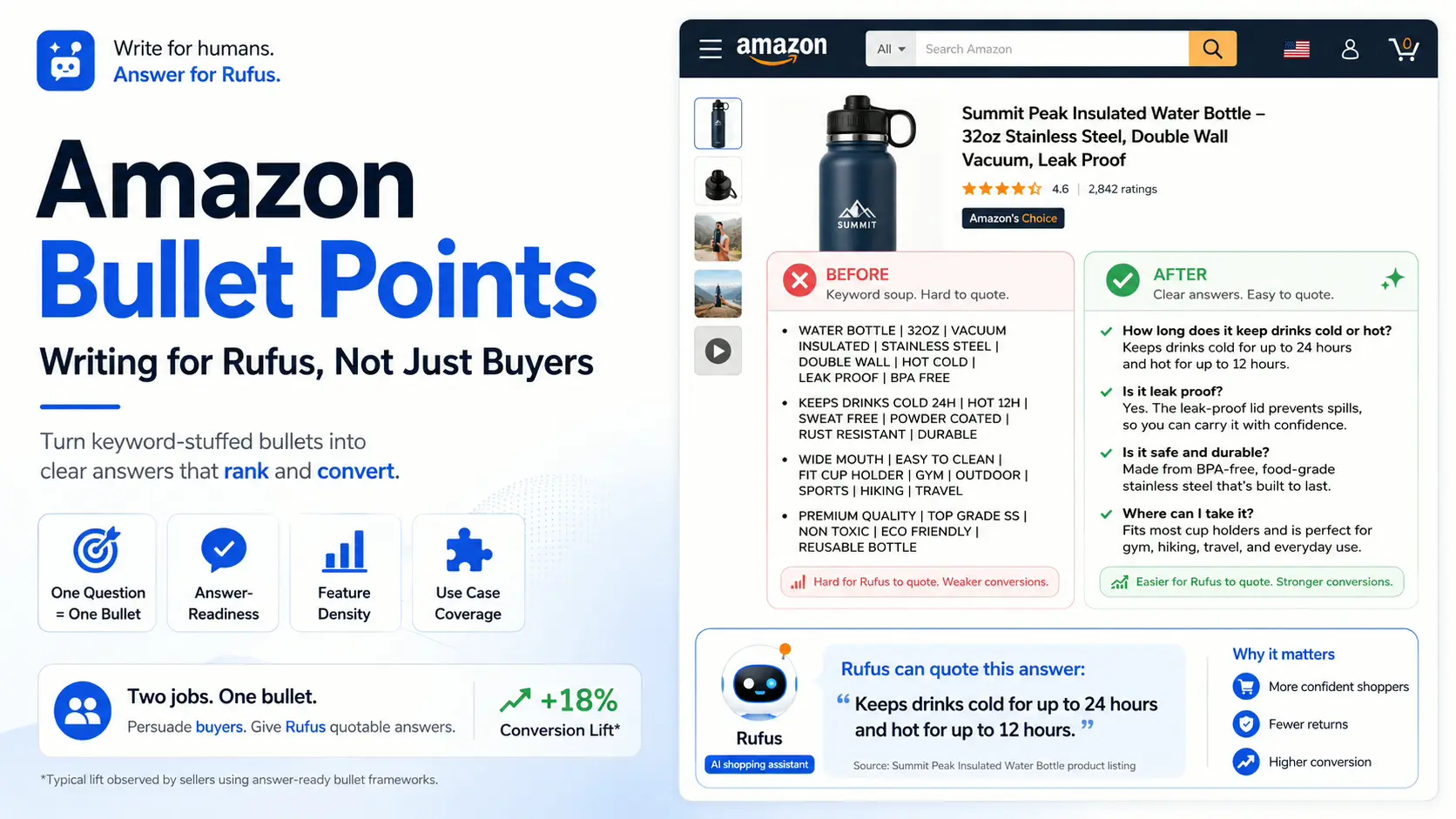
Update, 28 September 2026. Rufus was retired on 13 May 2026 and folded into Alexa for Shopping. Read every mention of Rufus below as “Amazon’s shopping assistant.” The advice is unaffected, and there is now a second reason to care about specific bullets: Amazon generates sponsored ad copy from your detail page, so a vague bullet becomes a vague pitch you pay for.
The five bullet points on your Amazon listing are doing two jobs now.
The first job is the one they’ve always done. A shopper lands on your detail page, scans down from the main image, and reads the bullets to decide whether to keep reading or hit back and try a competitor. The bullets either close the gap between the title promise and the buy decision, or they don’t.
The second job is newer. Amazon’s AI shopping assistant, Rufus, reads your bullets to answer shopper questions. When a buyer asks “is this belt OK for high-heat desert riding?”, Rufus looks for the exact sentence in your listing that answers that question. If your bullets are pipe-separated keyword soup, Rufus has nothing to quote and your product gets skipped.
Most sellers are writing bullets for job one and accidentally failing job two. This post is how to write bullets that pass both.
If Rufus is new to you, start with What Is Amazon Rufus and The 8 Rufus Scoring Factors.
Why Old-Format Bullets Don’t Work Anymore
Open most Amazon listings in any category and you’ll see a variation of this pattern.
✅ PREMIUM QUALITY | HEAVY DUTY CONSTRUCTION | HIGH PERFORMANCE | MADE WITH DURABLE MATERIALS FOR LONG LASTING USE
Five bullets that all look like that. All caps, pipe separators, heavy adjective use, no specific features. This format evolved for a reason. It was easy to scan, it packed keywords into backend indexing, and it told shoppers (loudly) that this product was “good.”
It fails in 2026 for three reasons.
One. Rufus can’t pull a clean quote out of pipe-separated keyword strings. It can’t answer a shopper’s question by saying “the listing describes it as PREMIUM QUALITY | HEAVY DUTY.” That’s not an answer.
Two. Shoppers have learned that this format is a filler pattern. It looks like content but contains almost no information. Conversion-rate data from our audits shows that listings with all-caps pipe bullets convert measurably worse than listings with clean sentence bullets at equal traffic levels.
Three. The format is failing on four of the eight Rufus factors at once. It’s weak on Feature Density (all adjectives, no specs). It’s weak on Use Case Coverage (no named scenarios). It’s weak on Buyer Intent Alignment (speaks to no specific question). And it’s weak on Answer-Readiness (unquotable).
Every one of those failures costs you Rufus recommendations and shopper conversions.
The Core Rule: One Question, One Bullet
The single biggest unlock for bullet writing in the Rufus era is a rule that takes thirty seconds to explain and the rest of your career to master.
Each bullet answers exactly one question your target shopper asks before buying.
Not a feature. Not a benefit. A question.
Start by listing the five questions a real shopper asks before purchasing your product. For a Polaris RZR drive belt, those questions might be: Will it fit my model and year? Will it hold up under the conditions I ride in? How does it compare to the OEM part? What’s the expected lifespan? What happens if it fails?
Now map one bullet to each question. The bullet’s job is to contain a clean, quotable sentence that answers that question. Not to list every feature. Not to rank keywords. To answer.
This is the format change that separates 2023-era bullets from 2026-era ones.
The 5-Bullet Template
Here’s the skeleton we use when we rewrite bullets in audits. Each bullet has three parts: a leading clause that names the concern, a factual claim with specifics, and a short closer that reinforces the use case.
Bullet 1: Fit and Compatibility. “Engineered for Polaris RZR XP 1000 model years 2014 through 2024. Direct OEM replacement, no modifications required, installs with factory hardware.”
Bullet 2: Performance Under Use. “Reinforced aramid fiber construction handles sustained high-heat loads up to 300°F, so the belt holds up under extended dune and trail riding where stock belts typically slip.”
Bullet 3: Comparison to the Alternative. “Tested against OEM spec at our own dyno and matched or exceeded stock belt performance across 1,200 miles of mixed terrain, at roughly 40% of OEM retail price.”
Bullet 4: Durability and Lifespan. “Average tested lifespan of 2,500 to 3,000 miles under aggressive riding conditions, which matches or exceeds the OEM replacement interval for most recreational riders.”
Bullet 5: Trust and Support. “Backed by a 12-month replacement guarantee and shipped from our US warehouse. If the belt fails within the warranty window, we replace it, no questions.”
Each bullet answers a distinct shopper question. Each contains at least one concrete specification. Each names a use case or scenario by name. Each is a quotable sentence Rufus can lift directly.
Write like this and you’re passing on Feature Density, Use Case Coverage, Buyer Intent Alignment, and Answer-Readiness simultaneously.
What Not to Do
Some things to actively avoid.
Don’t use all caps. ALL CAPS signals keyword-dump to both Rufus and shoppers. Title case or sentence case is fine.
Don’t use pipes, slashes, or long dashes as separators. Use commas and sentences. The bullet should read as English.
Don’t start every bullet with the same word. Sellers love opening every bullet with PREMIUM or EASY or SUPERIOR. This is a tell for a generic template and burns a valuable first-word position on nothing.
Don’t stuff keywords. If you can’t fit your primary keywords into clean sentences, something is wrong with the sentences. The keyword goes inside the answer, not in front of it.
Don’t repeat what’s in the title. Bullets are additional information. If the title already says “Polaris RZR XP 1000,” the bullets shouldn’t say “Polaris RZR XP 1000” five more times.
Before and After on a Real Listing
Here’s the same product before and after a bullet rewrite.
Before:
✅ PREMIUM QUALITY: High performance drive belt built with superior materials ✅ HEAVY DUTY: Durable construction for long lasting performance in all conditions ✅ EASY INSTALL: Simple installation with included hardware, no modifications required ✅ UNIVERSAL FIT: Fits most Polaris RZR models, please check fitment guide ✅ 100% SATISFACTION: We stand behind our products with full customer support
Read those five bullets and try to answer the question “will this belt survive a 300-mile dune trip in August?” You can’t. There’s nothing concrete to pull from.
After (using the 5-bullet template):
Engineered for Polaris RZR XP 1000 model years 2014 through 2024. Direct OEM replacement, no modifications required, installs with factory hardware.
Reinforced aramid fiber construction handles sustained high-heat loads up to 300°F, so the belt holds up under extended dune and trail riding where stock belts typically slip.
Tested against OEM spec at our own dyno and matched or exceeded stock belt performance across 1,200 miles of mixed terrain, at roughly 40% of OEM retail price.
Average tested lifespan of 2,500 to 3,000 miles under aggressive riding conditions, which matches or exceeds the OEM replacement interval for most recreational riders.
Backed by a 12-month replacement guarantee and shipped from our US warehouse. If the belt fails within the warranty window, we replace it, no questions.
Now ask the same question. “Will this belt survive a 300-mile dune trip in August?” The second bullet answers that directly. Rufus can quote the sentence. The shopper’s objection is handled without a message to seller support.
How to Audit Your Current Bullets in 5 Minutes
Pull up your current bullets. Run through this.
First, write down the five most common questions a real shopper asks before buying your product. Ask a CX person on your team if you have one. Look at the Q&A section on your listing.
Second, for each question, find the sentence in your bullets that answers it. If there isn’t one, that bullet is failing its job.
Third, count the specifications in your bullets. Numbers, measurements, material names, model compatibilities. If you have fewer than five specific specs across all five bullets, you’re failing Feature Density.
Fourth, count the adjectives. Premium, heavy-duty, superior, professional. If you have more adjectives than specifications, swap half the adjectives for concrete facts.
Fifth, read the bullets out loud. If it sounds like marketing slogans rather than answers, rewrite in sentences.
The Order of Operations
If you’re optimizing a listing from scratch, work in this order. Fix the title first (see Amazon Title Optimization). Fix the bullets second. Then move to images, then A+ content.
Bullets are the second-biggest lever in a listing because they’re where Answer-Readiness lives, and Answer-Readiness is the factor most sellers hadn’t even heard of before 2025. Fix it and you separate yourself from the pack.
Get a Free ListPilot Audit of Your ASIN
Paste your listing into ListPilot and we’ll score your bullets across all eight Rufus factors, surface your revenue leak, and show you exactly what to change. No credit card. No sales call.
Tahir Khan is the founder of ListPilot and previously the technical co-founder of ParkingSoft, a cloud-based parking software company acquired by T2Systems. He writes about Amazon listing optimization, AI-era ranking, and what seven-figure sellers are doing differently.
About
RockitSeller makes software for Amazon sellers who are done guessing - starting with ListPilot, which scores any listing against the signals that correlate strongest with how Amazon ranks today and rewrites what’s costing you sales.
facebook X instagram linkedin youtube
Contact
+1(770) 857-3352
Policies