
What is Your True Amazon Listing Cost?
Let’s break down the real cost behind your Amazon listings so you can stop profit leaks and recover your profit margins.
You’d be surprised at the details that go into making a successful Amazon listing or ending up with a silent margin drain.
A key problem is that you can’t find these leaks in one place. Rather, they spread across marketing, finance and ops. So, you must take care of separate blind spots so that each Amazon listing brings in more profit with less investment.
The True Cost of an Amazon Listing
Costs seem like isolated anomalies when we first look at them, but they’re actually interconnected and cumulative - especially when it comes to a product listing on Amazon listings, since these are what make or break conversions.
Product listings come with both visible and hidden costs:
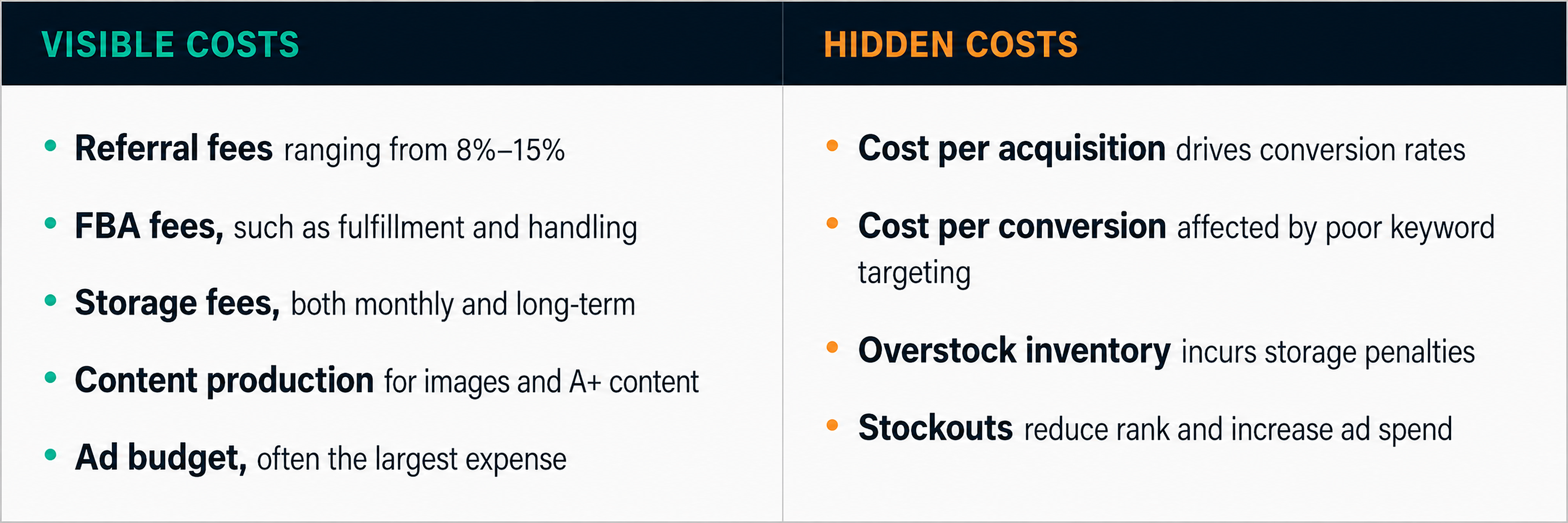
True Landed Cost (Per Amazon Listing)
Imagine that you sell plastic water bottles under the Sports and Outdoors category. Production per bottle costs $5 and you sell them for $20. So, customers pay $25 for the product and $1.50, with free Prime shipping. What’s your seller bill look like at the end?
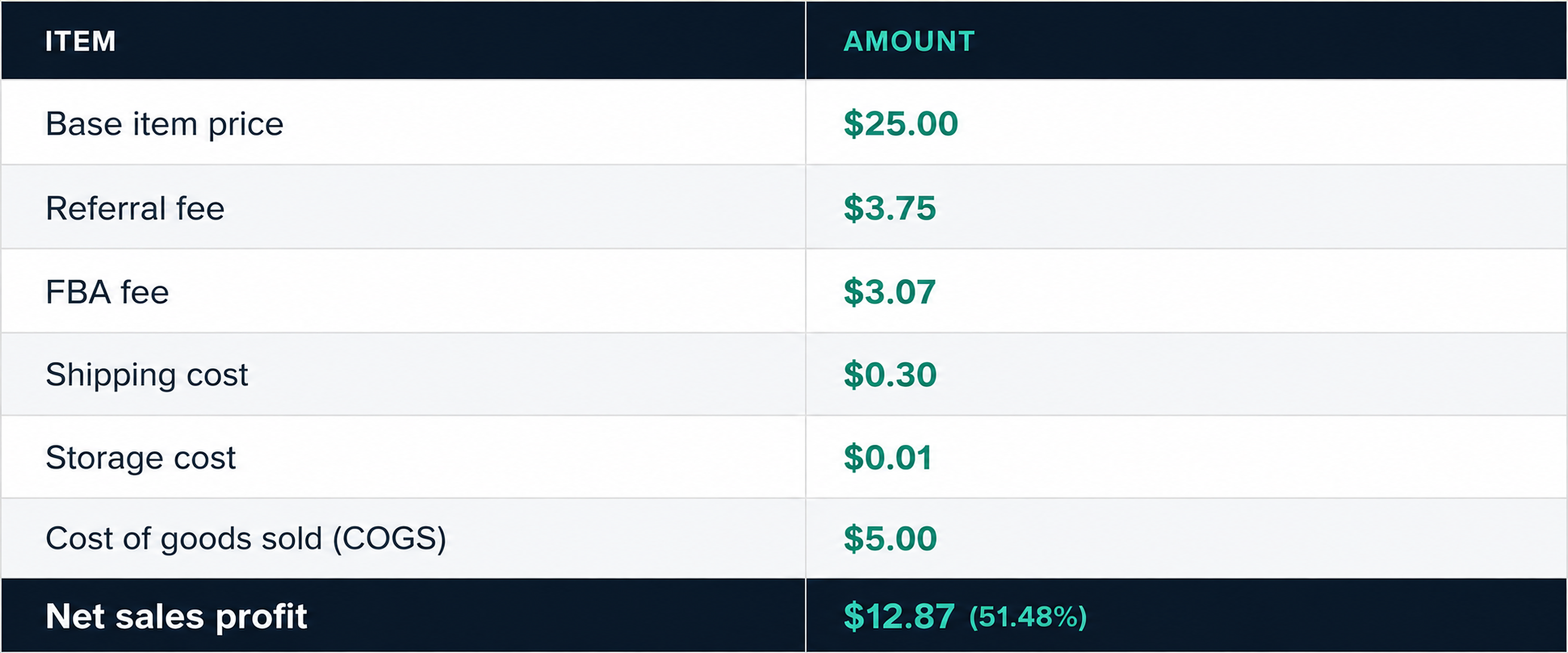
Add to this the costs of creating an Amazon listing, and then promoting said content… You can see how your investment stacks up and drains your profits.
This is why you need to calculate and understand the true landed cost of listing products on amazon, which includes:
- Product cost
- Shipping and logistics
- Platform fees
- Advertising
- Operational overhead
Such a broad view of your spendings will help you reveal the listings that seem profitable, but that actually underperform in the long run.
Note: referral fees vary, depending on product category.
Amazon Listing Cost Calculation
Here’s a core formula to calculate the cost per unit of each product listing on Amazon:
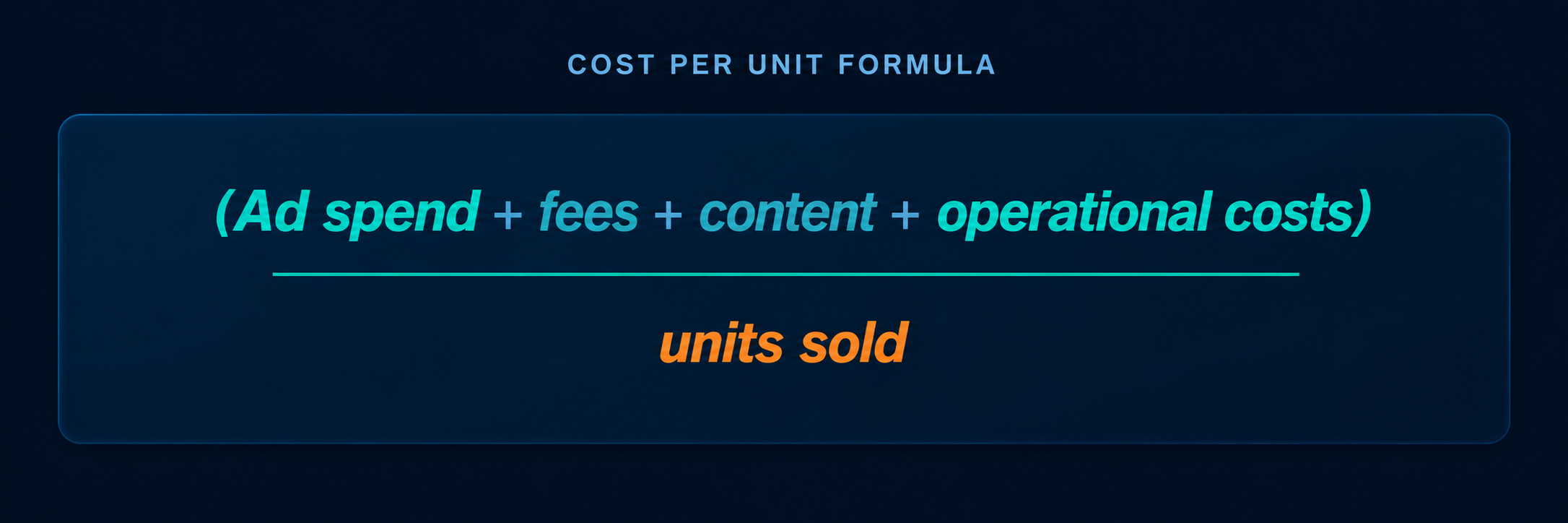
You should also keep track of specific KPIs directly affected by listing performance:
- TACoS
- Contribution margin
- Conversion rate (CVR)
- CPC trends
Monitoring is a continuous effort. So, make sure to perform regular listing audits to track performance over time, and adjust your listing strategy as needed.
Where Listings Leak Profit (and How to Fix it)
Poor Amazon product listing performance usually happens due to small inefficiencies across ad spend, conversion rates, referral and FBA fees, and inventory performance. When any of these go unchecked, they show rising TACoS, lower contribution margin, and poor IPI scores.
Low Conversion Rates
Amazon listings with improper optimization lead to poor conversion rates. To fix the issue, you might think that it’s necessary to increase your ad spend.
The thinking is simple: advertising leads to more clicks, but what if it only generates the same amount of sales as before? Cost per conversion (CPC) rises - due to poor relevance - and your Total Average Cost of Sales (TACoS) inflates.
In contrast, an optimized Amazon listing converts traffic effectively, does not depend on paid channels, and manages ad spend with efficiency across campaigns.
Solution: Conversion-First Content
Make sure that your copywriting and images clearly communicate the product’s value to customers. Address their objections and let them know how your product can solve their problem.
Weak SEO and Organic Visibility
Writing with the right search terms in mind will make Amazon notice your product listings, but there’s also a strategy to it.
You don’t rank for all keywords you can think of. Without proper keyword optimization, you’d rely too much on paid traffic, which will eventually cut on your margins. Plus, you’d risk being overlooked by organic searches, being eventually buried among competitors.
Solution Full-Funnel Keyword Strategy
Align your keywords with the user’s intent across the sales funnel to optimize ad spend. Use discovery terms at the top, comparison keywords at the mid stage; and high-intent purchase terms to convert at the bottom.
Inefficient PPC Structures
Big budgets do not guarantee performance nor growth. What if you overfund low-converting listings and underfund high-margin products? Misaligned PPC budgets lead to wasted spend on irrelevant keywords, and poor customer segmentation - between branded and non-branded traffic.
Solution: PPC- Listing Alignment
Adjust your PPC budget so it matches your sales. In other words, pair high-performing keywords with your ads so they match your content. Then, review your conversion data, and adjust your PPC budget to boost the best-selling listings you have.
Inventory Mismanagement
How you handle stock to meet demand directly impacts your Amazon listing performance. Overstocks and understock are perfect examples.
The first one incurs higher storage fees when sales are slow. Plus, you’d want to raise your ad budget to get rid of stagnated products. Understock, in contrast, resets rankings because you can’t meet demand. Thus, your PPC campaigns underperform and your revenue stalls.
This all leads to a low Inventory Performance Index (IPI), affecting your storage capacity and fees.
Solution: Inventory Planning
Keep healthy (and flexible) stock levels to support your product listing performance. Flexibility prevents overstocking and stockouts, which keeps sales flowing and improves sell-through rates.
A healthy IPI threshold is set at 500. Anything lower and you’d face operational inefficiencies affecting storage, shipping and sales.
Competitor Benchmarks
Chances are that your competitors’ listings target the same keywords as yours - not to mention customers. So, they may reveal a few things that can help you to win conversion from them; for instance:
- Content quality as images, A+ content and brand storytelling
- Keyword depth and relevance
- Pricing strategy that preserves value and invests in product leadership
- Customer ratings that shed light on sales volume, selling rates and value.
Analyzing your competitors could give you a roadmap to optimize your Amazon listings.
Turn Amazon Listings into Profit Engines
Some sellers think that the ads are the root cause of poor listing performance. That is not always the case, as it turned out for a bakery packaging brand we worked with. Our client was spending on clicks that landed on poor-converting pages.
Running a deeper analysis on their strategy, we discovered that the listings were the problem. So, we executed a Content-First Profit Unlock:
- Fix the landing page that turns clicks into orders
- Let the paid ads start converting
- Tighten ad spend on top of the foundation.
The result? The business went from earning $240 a month to $2,745. That’s a 1,046% profit increase. And the curve keeps bending up.
Successful product listings are created with data-driven content aligned with a targeted PPC strategy and flexible inventory levels. Amazon seller services like the AMZ Accelerator program are set to integrate these areas to unlock your potential gains, based on your resources and goals.
We specialize in creating in-depth strategies to boost conversion rates with both organic and PPC tactics, streamlining your branding to scale performance. In doing so, we can optimize your amazon listing costs and turn them into smart profit engines for your brand.